An Introduction to Bitcoin Decentralized Exchanges
An Introduction to Bitcoin Decentralized Exchanges

As Bitcoin DeFi continues to grow, decentralized applications like exchanges will be critical for trustless trading and transacting.
Here, we will provide an overview of decentralized cryptocurrency exchanges and explain how they work with the Bitcoin network.
What is a Decentralized Exchange (DEX)?
A decentralized exchange (DEX) is a type of cryptocurrency exchange that operates without a central authority. This means that it is not controlled by any single entity, such as an institution or organization. Instead, the exchange platform relies on a protocol to facilitate trades and maintain its integrity.
On a decentralized crypto exchange, liquidity is dependent on the amount of tokens locked within a liquidity pool. Each liquidity pool is made up of one trading pair, with both crypto assets being supplied by liquidity providers. To incentivize increased liquidity, providers are rewarded with tokens that are accrued from transaction fees on the trading platform.
Through smart contracts and Automated Market Makers (AMMs), liquidity pools remain autonomous and automatically adjust to maintain the proper prices of tokens.
Decentralized Exchange vs. Centralized Exchange
Decentralized exchanges can be contrasted with centralized exchanges, which are controlled by an intermediary and often require users to deposit their funds into the exchange's custodial wallet. This centralization introduces a few considerable disadvantages, such as being vulnerable to hacks, fraud, and other types of mismanagement on behalf of the exchange. Decentralized exchanges, on the other hand, offer greater security and autonomy to traders.
One inconvenience that most decentralized exchanges have is that they are difficult to use when transferring from fiat to cryptocurrency. Many DEXs currently do not support fiat-to-crypto exchanges, mainly due to lack of technology or regulatory blockades.
How Does a Decentralized Exchange Work?
A decentralized exchange allows users to trade between two cryptocurrencies through direct, peer-to-peer transactions, all without the reliance on a third party. This is achieved by using smart contracts, which are self-executing contracts that are encoded with the terms of the agreement for a transaction.
When a user wants to make a trade on a decentralized exchange, they create a trade order and broadcast it to the network. This order is then matched with another user who is looking to trade the opposite side of the order. The smart contract then automatically executes the trade and updates the balances of both users.
Why Use a Decentralized Exchange?
There are a number of benefits to using a decentralized exchange for trading cryptocurrencies:
Custody
The greatest benefit of DEXs is that they let traders retain complete ownership of their funds. With a centralized exchange, users must deposit their digital assets in a custodial wallet, which is ultimately controlled by the exchange. This can lead to loss of funds through hacks, frauds, or even insolvency by the exchange. Decentralized exchanges can offer greater security for funds when using a non-custodial wallet, where the user is the only one with access to the private keys. Since users remain in full control, there is less risk of funds being lost or stolen.
Privacy
Transactions are settled directly between traders, there is no central authority collecting user data. Oftentimes, centralized exchanges use “Know Your Customer” (KYC) which requires creating an account with credentials like your name, address, date of birth. Moreover, additional government-issued documentation like photo IDs or similar documents may also need to be presented for verification. DEXs can be appealing for traders who value their privacy and want to keep some element of anonymity when carrying out financial transactions.
Censorship resistance
Decentralized exchanges are designed to be resistant to censorship. This can be important in jurisdictions with strict regulations on financial transactions, as it allows users to trade freely without the risk of their transactions being suspended or shut down.
Reduced risk of hacks
Centralized exchanges are vulnerable to hacks, as they hold large amounts of user funds in their custodial wallets. Decentralized exchanges, on the other hand, do not hold user funds or personal data, and therefore have a reduced risk of being hacked.
Is There a Decentralized Exchange for Bitcoin?
There are a few decentralized exchanges that allow users to trade their native BTC for cryptocurrencies on other blockchains.
Before we discuss Bitcoin DEXs, it is important to understand how it differs from other blockchains in terms of asset issuance.
Since its inception, the Bitcoin mainchain has had just one asset, BTC. This is in contrast to many other leading blockchains like Ethereum, which has thousands of digital assets issued in addition to its native token, ETH. With Bitcoin being a single-asset at its base layer, there is essentially no need for a DEX.
However, there are decentralized exchanges that enable users to send and receive BTC to other blockchains.
Let’s take a look at examples of some of the top decentralized exchanges for Bitcoin.
Decentralized Exchanges for Bitcoin
If you want to exchange BTC for another crypto asset, you will need to transfer it to another blockchain. Some of these blockchains are layered solutions, which are specifically developed to bring additional functionality and scalability to the network. For example, Stacks is a layer that brings smart contracts and decentralized applications (dApps) to Bitcoin.
One DEX built for Bitcoin on Stacks is Stackswap.
Stackswap
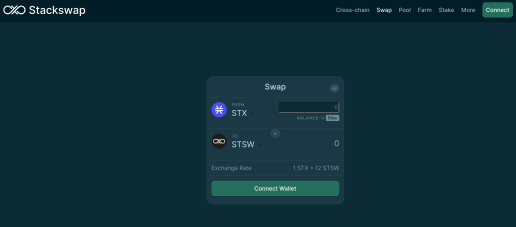
Stackswap is a cross-chain DEX for swapping BTC, ETH, and USDC (ERC20) with Stacks-based tokens (SIPs). With Stackswap, Bitcoin users can have a seamless on-ramp to explore the Stacks ecosystem of DeFi and other Web3 dApps. The platform utilizes Hiro, Stacks’ native wallet for swapping assets and STX tokens for transaction fees
In addition to Bitcoin’s layers, there are other blockchain and protocols with no direct relationship to the mainchain that also allow users to trade BTC for alternative crypto assets. Two examples of this are Bisq and THORChain.
Bisq
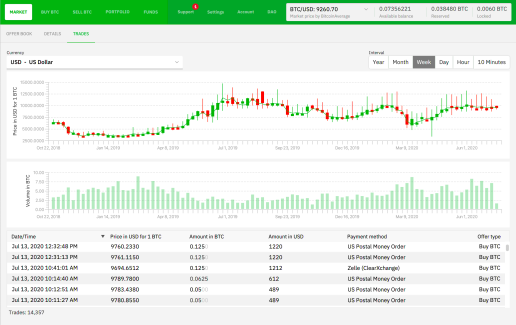
Bisq is an off-chain, peer-to-peer decentralized crypto trading platform for buying and selling BTC in exchange for fiat and other cryptocurrencies. The Bisq exchange utilizes a network of nodes to facilitate trades between users. The software is designed to make transactions more secure, private, and censorship resistant than those executed on centralized exchanges. Bisq uses a multi-signature escrow process, which holds onto funds until a trade is completed and offers a decentralized dispute resolution system to resolve any issues.


Comments
Post a Comment